![S911logo350350-2.png]](https://help.getshare911.com/hs-fs/hubfs/S911logo350350-2.png?width=40&height=40&name=S911logo350350-2.png)
Before you start: how do alerts reach you?
Share911 can reach you two different ways, and they are set up separately. Most people get both. Check which ones apply to you:
- Text message from the short code 48502. Everyone enrolled gets these.
- App notification, if you have the Share911 app installed on your phone.
If you have the app, you need to do both halves below. Setting up only one is the single most common reason people miss an alert.
Don't have the app? Download the Share911 mobile app — it's the more reliable of the two paths, and it's how you check in during an incident.
iPhone
If you have an Android phone, skip to the Android section.
Step 1 — Fix your Share911 contact first
This is the step people skip, and it quietly breaks everything that follows.
Share911 now sends all text alerts from the short code 48502. If your saved contact still has an older 10-digit number, every setting below will be attached to a number that will never text you.
- Open Contacts.
- Find Share911.
- Confirm the number reads exactly 48502. If it doesn't, tap Edit and change it.
- No contact at all? Tap +, name it Share911, and add 48502 as the phone number.
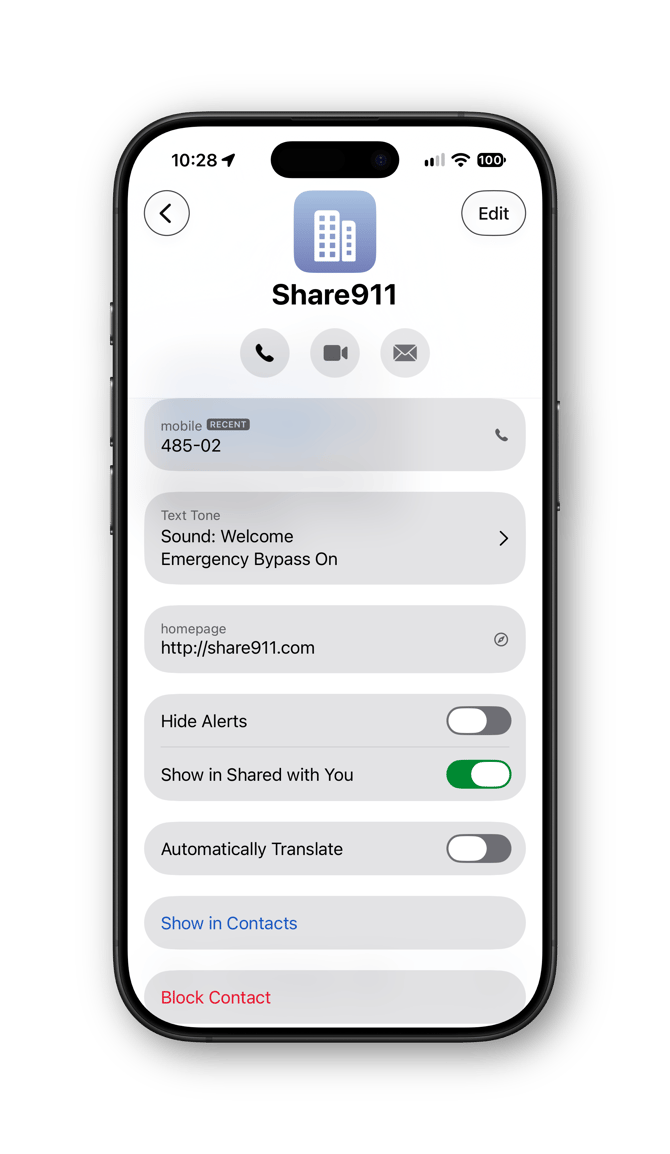
Step 2 — Give it a loud, unmistakable tone
You want a sound you will never confuse with a group text.
- On the Share911 contact, tap Edit.
- Tap Text Tone.
- Pick something loud and distinct — Alert, Alarm, or Sonar work well. Avoid your default.
- Tap Done, then Done again.
Pick something you'll recognize from across a classroom or down a hallway. Some organizations standardize on one tone so the whole building recognizes it — ask your Share911 administrator if yours has.
Step 3 — Turn on Emergency Bypass
Emergency Bypass lets this one contact make noise even when your phone is silenced.
- On the Share911 contact, tap Edit.
- Tap Text Tone.
- Turn on Emergency Bypass. The switch turns green.
- Tap Done, then Done again.
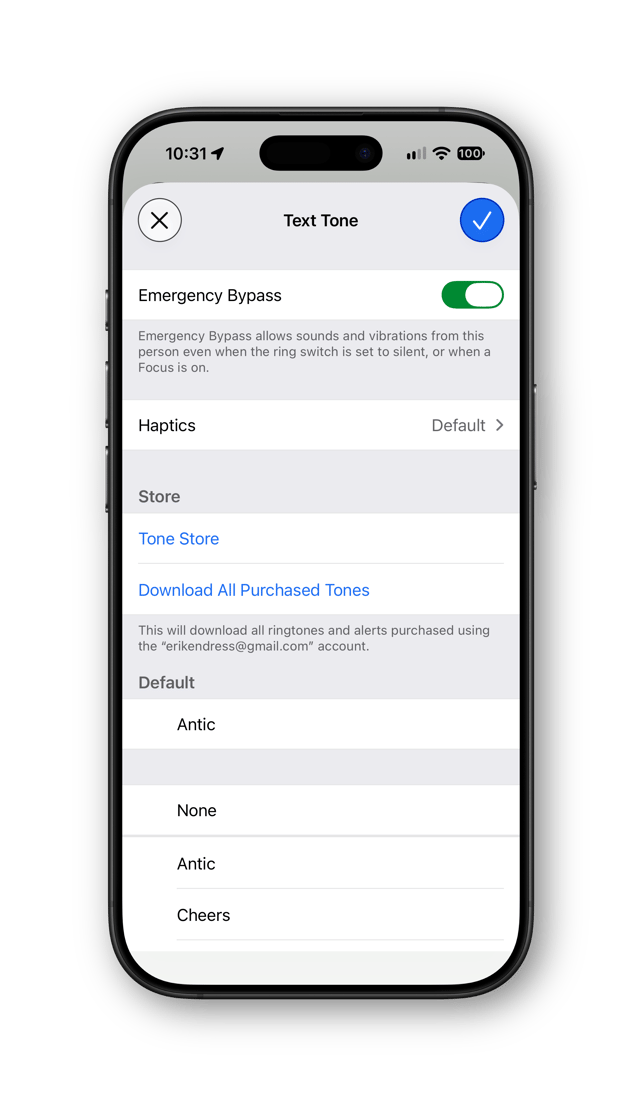
Also getting phone calls from Share911? Emergency Bypass on Ringtone is a separate switch. Tap Edit → Ringtone and turn it on there too.
Step 4 — Set up your app notifications
Skip this step if you don't have the app. Emergency Bypass does not cover app notifications — that's a separate system, and this is where most "I did everything and still missed it" cases come from.
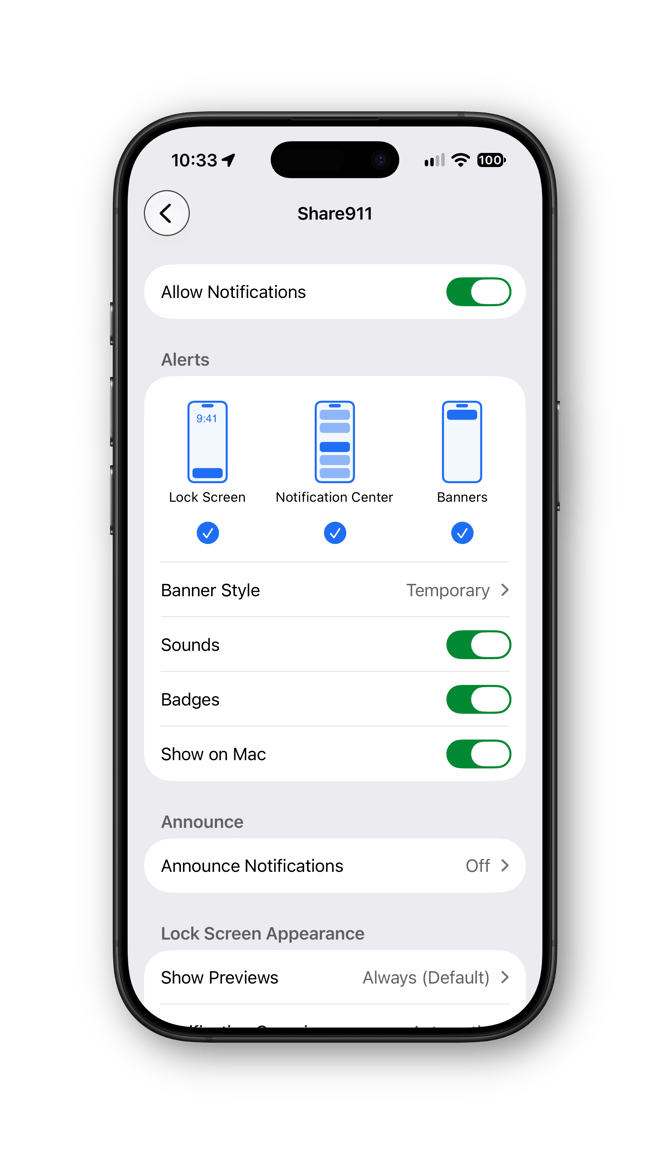
- Open Settings → Notifications → Share911.
- Turn on Allow Notifications.
- Turn on Sounds.
- Turn on Time Sensitive Notifications.
- Make sure Lock Screen, Notification Center, and Banners are all checked.
Step 5 — Check every Focus you use
This is the step that catches almost everyone.
Focus modes — Work, Sleep, Personal, Driving, Do Not Disturb, and any custom one — are each configured separately. Setting up your Work Focus does nothing for your Sleep Focus.
That matters more than it sounds. A lot of the alerts that matter most — an overnight facility emergency, an early-morning incident before staff arrive — land while Sleep Focus is running.
For each Focus you actually use:
- Go to Settings → Focus and tap the Focus (start with Work and Sleep).
- Tap People → Allow Notifications From, tap +, and add your Share911 contact.
- Tap Apps → Allow Notifications From, tap +, and add Share911.
- On that same Apps screen, turn on Time Sensitive Notifications.
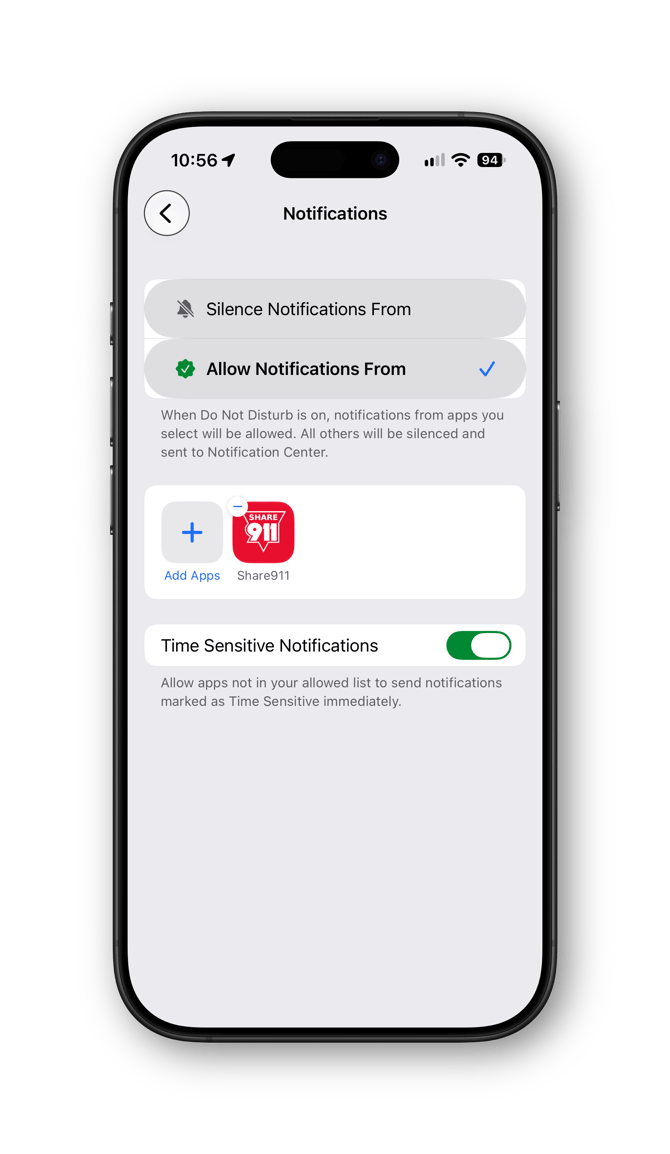
Repeat for Sleep, Driving, Do Not Disturb, and any custom or school-provided Focus. It's tedious once and then it's done.
Step 6 — Two settings that silently undo all of it
Alert volume. Go to Settings → Sounds & Haptics and drag the Ringtone and Alerts slider up. Then turn off Change with Buttons. Otherwise, turning your volume down during a meeting also turns your emergency alert down — and it stays down.
The silence switch. If your iPhone has the physical switch on the side, leaving it on silent is fine for Emergency Bypass texts, but it will silence app notifications. On iPhone 15 Pro and newer, this is the Action Button instead — check that you haven't set it to toggle Silent Mode and left it on.
If you rely on the app for alerts, don't leave the phone in Silent Mode. Use a Focus mode instead — that's what Steps 4 and 5 configured, and it's the setup that lets you stay quiet during the day while still hearing an emergency.
Apple Watch
If you wear an Apple Watch, it changes where your notifications go. When the Watch is on your wrist and unlocked, iPhone notifications get routed to the Watch instead of the phone — so the loud tone you just set up on the iPhone doesn't play.
Set expectations first: your Watch will tap you, not play your custom Share911 tone. Custom text tones live on the iPhone. If you're waiting to hear the tone on your wrist, you'll think this is broken when it isn't.
Make the tap impossible to miss:
- On your iPhone, open the Watch app.
- Go to Sounds & Haptics.
- Turn Silent Mode off.
- Drag Alert Volume up.
- Turn on Prominent Haptic and set Haptic Strength to maximum.
- Turn Cover to Mute off.
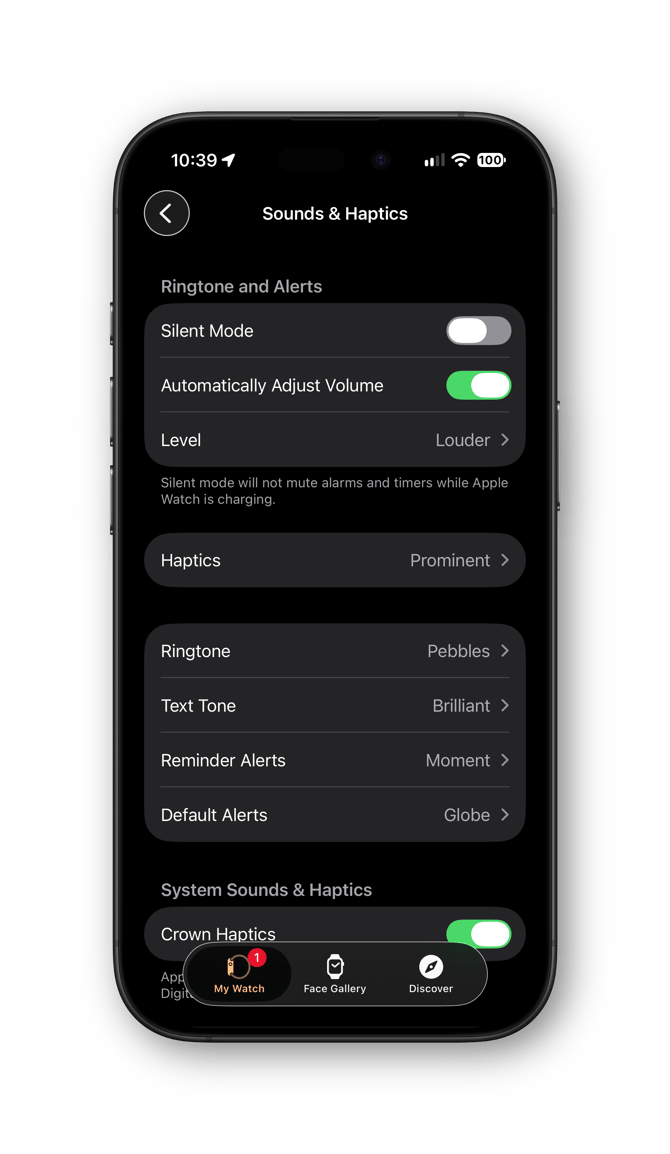
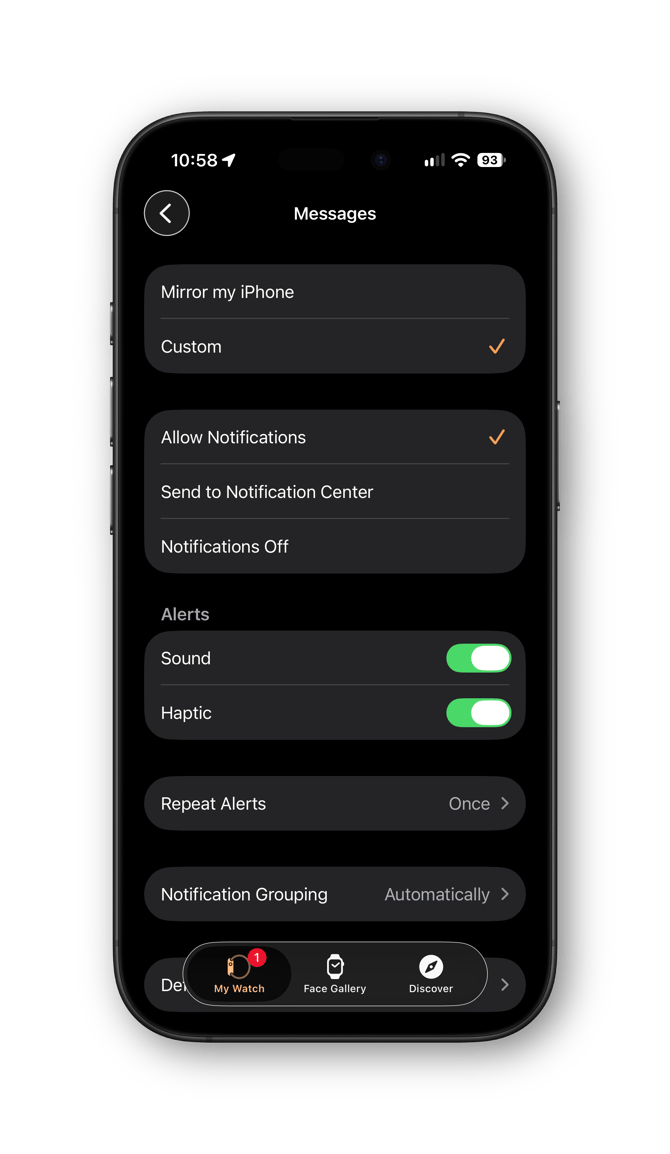
Then confirm messages themselves alert you:
- In the Watch app, go to Messages.
- Tap Custom.
- Make sure Sound and Haptic are both on.
Also check Watch app → Focus. Focus modes mirror from your iPhone, so a Focus that silences the Watch will silence it even after everything above.
The older advice, and why we changed it. We used to recommend setting Messages to Send to Notification Center, which pushes alerts back to the iPhone. It works, but it turns off text notifications on your Watch entirely — a real cost if you wear it all day. Use it only if you've tried the above and still can't feel the alert.
Android
Android varies quite a bit by manufacturer. The steps below cover Pixel and stock Android first, then Samsung. If you have a different phone, the setting names are usually close.
Step 1 — Fix your Share911 contact
- Open Contacts.
- Find Share911 and confirm the number is exactly 48502.
- No contact? Create one named Share911 with 48502.
- Open the contact and tap the star to mark it a favorite. Do Not Disturb rules key off this.
Step 2 — Give it a loud tone
Google Messages: open the Share911 conversation → ⋮ → Details → Notifications → Sound, and pick something loud and distinct.
Samsung Messages: open the conversation → ⋮ → Notification settings → choose a sound.
Verizon Message+: tap the message → ⋮ → Customize → Tones.
Step 3 — Let Share911 through Do Not Disturb
Pixel / stock Android:
- Settings → Notifications → Do Not Disturb.
- Tap People → Messages, and choose Starred contacts.
- Tap Calls and choose Starred contacts as well.
Samsung (One UI):
- Settings → Notifications → Do not disturb.
- Tap Allow exceptions → Custom.
- Under Calls and messages, allow Favorite contacts only.
Step 4 — Let the app override Do Not Disturb
Skip this step if you don't have the app.
This is Android's equivalent of Emergency Bypass, and it's the most reliable setting on the platform. It's also the one nobody finds on their own.
Pixel / stock Android:
- Settings → Notifications → App notifications → Share911.
- Tap the alert category (usually named Alerts or Emergency).
- Set Importance to Urgent so it makes sound and pops on screen.
- Turn on Override Do Not Disturb.
Samsung (One UI):
- Settings → Apps → Share911 → Notifications.
- Tap the alert category.
- Set Alert type to Sound, choose a loud sound, and turn on Override Do Not Disturb.
Step 5 — Turn Do Not Disturb on, and check your volume
Lowering your ringer volume is not the same as Do Not Disturb, and the exceptions above only apply in Do Not Disturb. If you want a quiet phone that still alerts you for Share911, turn Do Not Disturb on rather than turning the volume down.
You can schedule it: Settings → Notifications → Do Not Disturb → Schedules — for example, on during school hours and overnight.
Then check Settings → Sound & vibration and make sure your Notification volume is up. Some phones let volume buttons drop it to zero without warning.
Test it — don't assume it worked
Every step above is invisible until an emergency, which is the worst possible time to find out you missed one. Take two minutes and prove it.
Ask your Share911 administrator to run a drill while you do this:
- Silence your phone the way you normally do during the workday.
- Turn on the Focus mode you normally use (Work, or whatever your organization uses).
- Lock the screen and set the phone down — don't hold it, don't look at it.
- Have your administrator broadcast a drill.
A correct result looks like this:
- Your phone makes noise — the loud tone you chose, not your normal text tone.
- It's loud enough to hear from across the room.
- If you have the app, you get both the text and the app notification.
- If you wear an Apple Watch, you feel a strong tap on your wrist.
If any of those didn't happen, see Troubleshooting below.
Administrators: running a drill and asking staff to confirm this in writing gives you documented proof of alert coverage, building by building. It's worth doing once a semester and after every new-hire onboarding round.
Troubleshooting
"I didn't hear the alert at all." Almost always one of three things: your contact still has an old 10-digit number instead of 48502; the Focus you were actually in wasn't configured (Work is set up, Sleep isn't); or you're relying on the app while the phone sits in Silent Mode. Work through Steps 1, 5, and 6.
"I got it, but it was silent — just a banner." The notification is arriving, the sound isn't. For texts, re-check Emergency Bypass (Step 3). For the app, check Settings → Notifications → Share911 → Sounds (Step 4). Then check that your alert volume wasn't dragged to zero (Step 6).
"It was quiet, not loud." Your Ringtone and Alerts slider is low. Turn Change with Buttons off so it stays where you set it.
"It worked during the day but I missed one overnight." Sleep Focus. Go back to Step 5 and add Share911 to it.
"It only alerts on my Watch, and I don't feel it." See the Apple Watch section. Turn on Prominent Haptic and turn off Cover to Mute.
"I set everything up and it still doesn't work." Contact us with your phone model, OS version, and which of the two paths (text, app, or both) failed. That last detail is the one that lets us solve it on the first reply.
During a real emergency
Once you've received the alert and you're somewhere that needs to stay quiet, you may want the phone to stop making noise.
Do this: press the volume down button, or press and hold the notification and mute the conversation for an hour.
Don't go dig through Contacts to turn off Emergency Bypass — it's seven taps you don't have, and it's easy to forget to turn back on afterward.
Related
- Downloading the Share911 mobile app
- Set up Share911 notifications (drills vs. active events)
- Desktop notifications
- Getting started for all employees